Dive Brief:
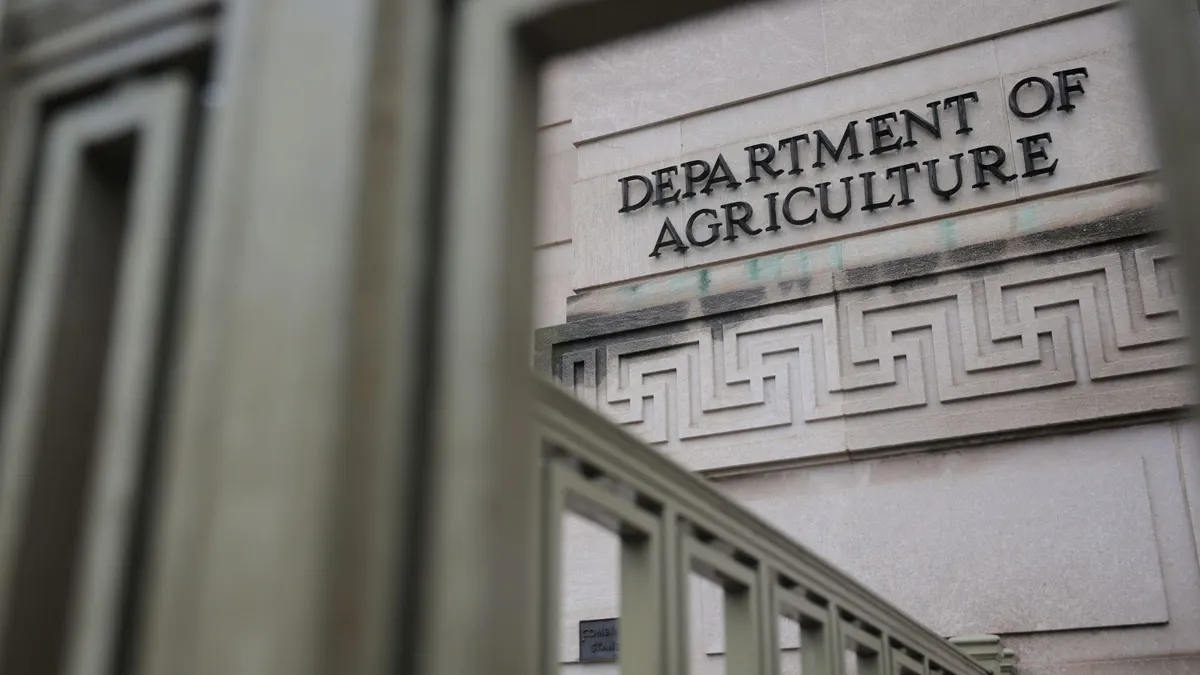
- Twenty-one state attorneys general on Monday sued the U.S. Department of Agriculture to stop the agency from enforcing new conditions that they say could threaten their states' ability to receive key federal funds for school meals and other nutrition programs.
- The lawsuit said that USDA created new requirements, effective Dec. 31, 2025, that prohibit all USDA grant recipients from using funds to “promote gender ideology” or for programs that “deprive women and girls of fair athletic opportunities” or that “provide incentives for illegal immigration.”
- The Democrat-led plaintiff states said they stand to collectively lose at least $11.6 billion in Child Nutrition Program funds under these requirements — and “the consequences would be grave.” Millions of children could lose access to nutritious meals, hindering their ability to learn and harming their health, the lawsuit said.
Dive Insight:
The USDA has indicated it will enforce the new 2026 conditions “aggressively and pursue harsh penalties for violations,” the attorneys general alleged in their lawsuit. A USDA spokesperson told K-12 Dive in a Tuesday email that the agency will not comment on pending litigation.
USDA announced the new grant requirements on Dec. 31, the same day the conditions went into effect. That day, U.S. Agriculture Secretary Brooke Rollins signed a Secretary’s Memorandum directing USDA agencies to adopt the “first-ever set” of General Terms and Conditions for all future awards.
Rollins said in a Dec. 31 statement that the new conditions will help USDA “take swift action when recipients and cooperators — and even recipients of subawards and subcontracts — are not compliant with Federal law and applicable Executive Orders.”
The suing states, however, allege that “USDA has no legal authority to impose the 2026 Conditions on the Child Nutrition Programs." Additionally, the lawsuit said, “Congress has not permitted USDA discretion to condition or withhold Child Nutrition Programs funds from Plaintiff States.”
In fiscal year 2026, Congress appropriated $37.8 billion for Child Nutrition Programs. These federal funds support the National School Lunch Program, School Breakfast Program, Child and Adult Care Food Program, Summer Food Service Program, Seamless Summer Option, Summer Electronic Benefit Transfer for Children Program, Fresh Fruit and Vegetable Program, and Special Milk Program.
USDA’s new conditions also prohibit recipients from using funds to “allow illegal aliens to obtain taxpayer-funded benefits,” the coalition's lawsuit said. Yet Congress mandates all school-aged children can participate in school meal programs “regardless of ‘citizenship, alienage, or immigration status,’” the lawsuit said.
The coalition of attorneys general charged that the new conditions “impose vague and broad terms” that states would have to accept without fundamentally understanding their meaning.
In the 2023-24 school year, 15.4 million children participated in school breakfast programs and 29.4 million used school lunch programs, according to federal data analyzed by the Food Research & Action Center in May 2025.
FRAC President Crystal FitzSimons pushed back on USDA's new requirements, saying in an emailed statement Tuesday to K-12 Dive, “No administration should put additional 'conditions' on school meal funding that would make school meal operations more burdensome or make it more difficult for children to access nutritious food at school."
FitzSimons noted that more than 94,000 schools can participate in the federal school lunch and breakfast programs, which are administered by state child nutrition agencies following rules set by federal law.
“Children can’t learn on an empty stomach. School meals are a critical nutrition and academic support for millions of children, particularly those from households with low incomes,” FitzSimons said in reaction to the lawsuit.
The suing states are: California, Colorado, Connecticut, Delaware, Hawaii, Illinois, Maine, Maryland, Massachusetts, Michigan, Minnesota, New Jersey, New Mexico, New York, Oregon, Rhode Island, Vermont, Virginia, Washington, Wisconsin, and the District of Columbia.
“The federal government cannot hold critical funding hostage to force states to comply with vague, ideological directives,” said New York State Attorney General Letitia James in a Monday statement. “These new conditions put essential programs at risk and cause chaos for states that rely on this funding to feed families, support farmers, and keep communities safe.”