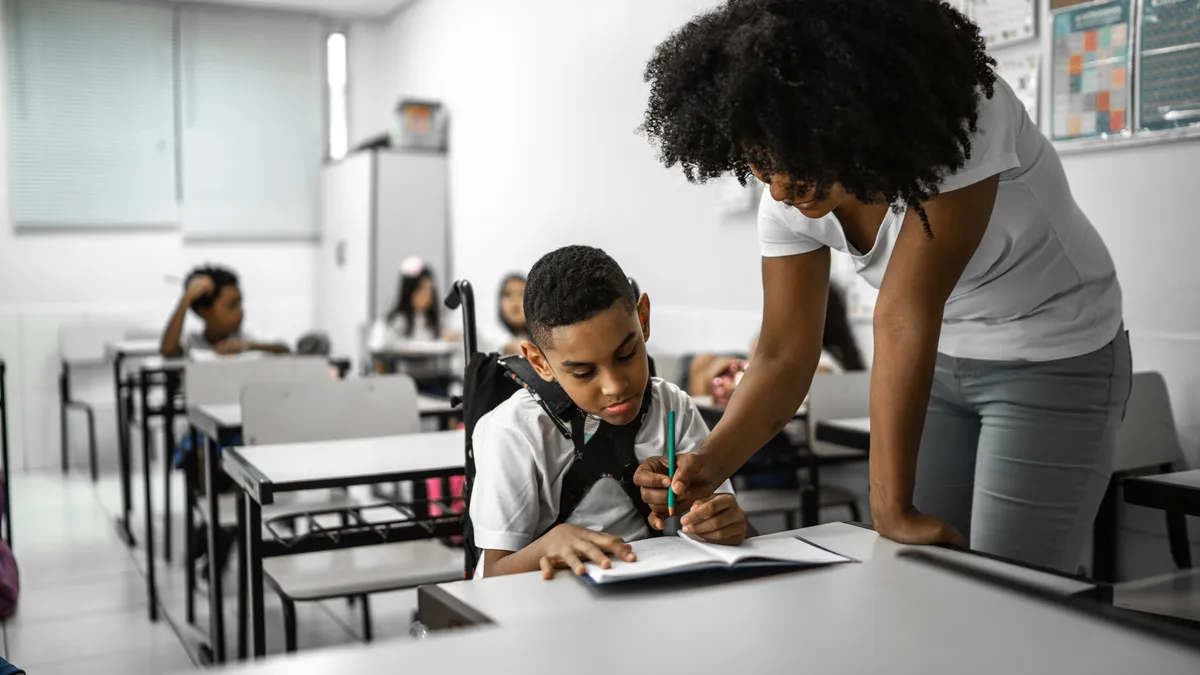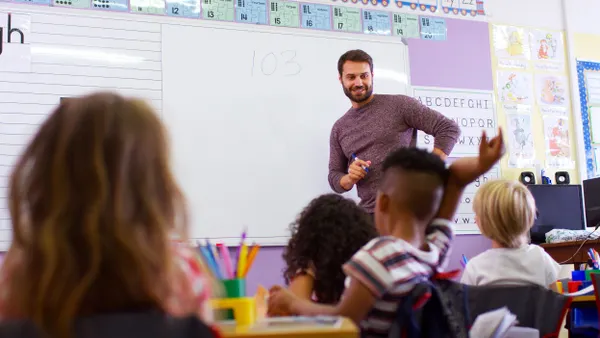
Educators might associate classroom jobs with elementary school students passing out pencils. But in Meredith Howard’s history and social studies classroom at Albert Hill Middle School in Richmond, Virginia, she “employs” students to do everything from monitoring attendance to troubleshooting technology to returning graded work.
“Sometimes, teachers are very loath to give up control,” Howard said. She recommends that teachers “identify something that takes up their time, something they’re always forgetting, something they wish they didn’t have to do, so they could do this other thing that’s more important.”
Pamela Randall, senior staff advisor for the Collaborating Districts Initiative at CASEL and a former high school principal, said that jobs for older students should be thoughtful in helping them form identity, build a connection to school and a sense of belonging, develop their leadership skills, and gain agency.
In Howard’s classroom, students pore over a list of job descriptions and apply for top choices, stating in writing why their skills, interests and experiences would make them a good fit.
“The first thing a teacher should do is identify places where there is something a student could absolutely do, even with a little bit of training,” she said. When she tells a student they would be good at something, 90% of the time they agree to do it, she added.
Howard suggests that teachers who want to initiate a jobs program start small and look at other educators’ lists — but don’t feel compelled to roll out the whole array.
“You’ve got to do what works for you,” she said. “Some classes don’t have the right vibe, the right mix of kids. You’ve got to give yourself grace and be flexible about this.”
Students need reminders in the first few weeks of the school year, which Howard handles with a mix of encouragement and admonishment: “I can’t wait until you guys are doing this?” she said. “I verbalize that to them. Why am I still passing out papers? I verbalize that.”
She also sometimes forgets who is supposed to be doing what, at first — although sometimes other students remind her. “There are a lot of kids in middle school and high school who are very aware of what other people should be doing,” Howard added.
Classroom jobs help students gain a sense of service to their peers and could be an inroad to their future career choices if they are meaningful, developmentally appropriate and tap into their passions, Randall said.
A high school student could lead their math class through a trigonometry problem, for instance, she said. “If they’re in front of the class leading a discussion, that will give them a sense of confidence that I can stand in front of a group of people and make a presentation. … That could lead to a career as a teacher, or in law.”
Howard said she hopes that students continue to do their chosen job for at least a semester — although that sometimes changes organically, such as when the attendance monitor in one class was absent fairly frequently.
Hiring can be challenging. “A lot of kids want a specific job,” she said. “I try to observe kids deeply in the first couple of weeks of school. Would they be good at this?”
If a student has a loud voice, for instance,they would be a good attendance monitor, she said, or a student who is out of their seat a lot could be a good fit as a supply manager.
On the social-emotional side, students gain executive functioning skills, practice in making responsible decisions, and social awareness of what’s important to classmates and adults in the school, Randall said.
“They’re going to have to be self-aware and self-managed enough to follow through on job tasks,” she said. “Building relationships is going to be threaded throughout.”
Students learn that they have something to contribute and that others are counting on them to do so, Howard said.
“You are invested in class in a different way,” she said. “If you don’t do your job, nobody gets a paper.”