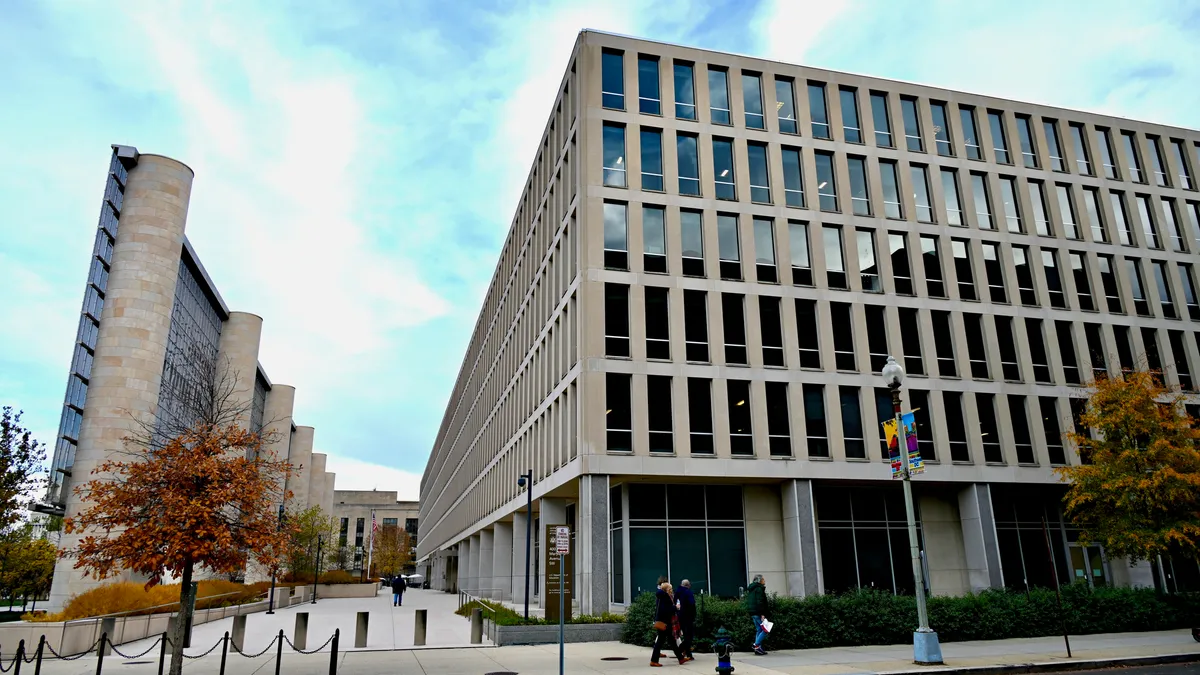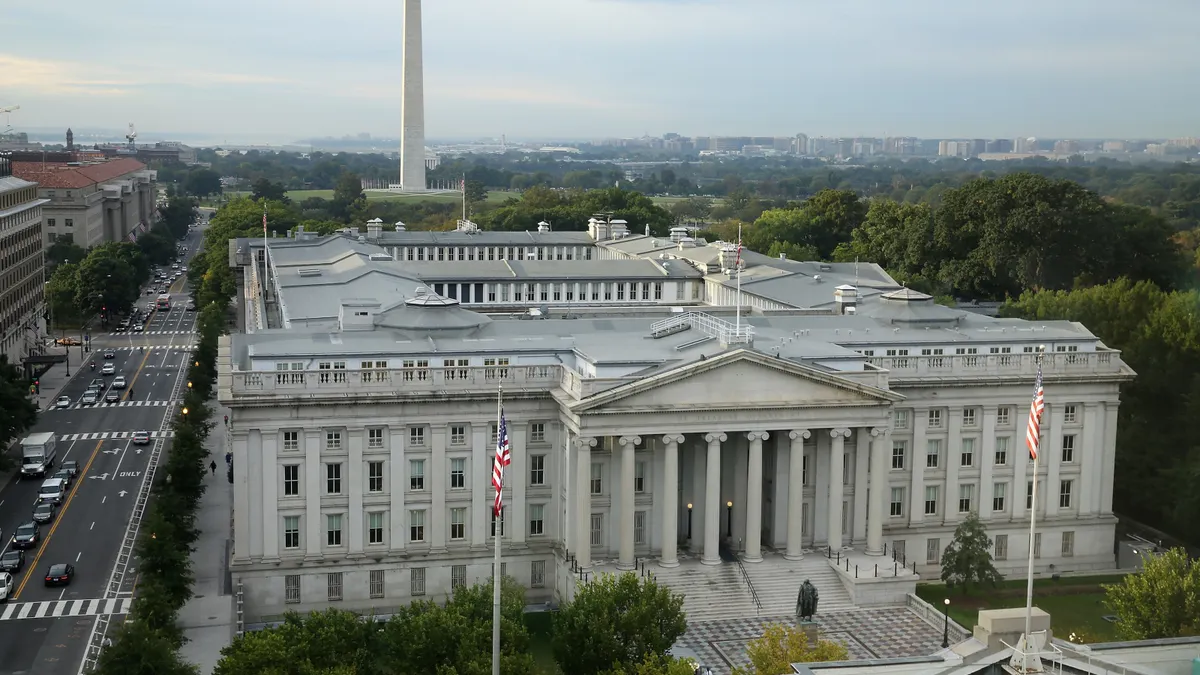

The U.S. Department of Education plans to gradually shift responsibility for the federal government’s roughly $1.7 trillion student loan portfolio to the U.S. Department of Treasury under a new partnership struck between the two agencies announced Thursday.
Before Thursday’s announcement, the Education Department had struck nine other agreements to transfer parts of its K-12 and higher education responsibilities to other agencies. The deals have ranged from having the U.S. Department of Labor administer programming for low-income school districts and academic supports to directing the U.S. Department of Health and Human Services to oversee K-12 school safety and family engagement activities.
Under the new agreement, the Treasury Department will start to “assume operational responsibility” for collecting on defaulted student loans. About 9 million borrowers have student loans in default, the agencies said Thursday.
Afterward, the two agencies plan for the Treasury Department to eventually manage the rest of the student loan portfolio “to the extent practicable, following Treasury’s assessment of the portfolio and its operations.” In the last stage, the department is set to administer the Free Application for Federal Student Aid.
The FAFSA form assists colleges in determining financial aid packages for applicants and gives applicants a better understanding of their financial aid eligibility when making decisions about where they want to enroll. According to the National College Attainment Network, the high school class of 2026 completed a collective 1.6 million federal student aid applications for higher education for the 2026-27 school year as of Jan. 23.
“We are undertaking the first serious effort to clean up a $1.7 trillion portfolio that has been badly mismanaged for years,” U.S. Treasury Secretary Scott Bessent said in a Thursday statement. “Treasury has the unique experience, the operational capability, and the financial expertise to bring long overdue financial discipline to the program and be better stewards of taxpayer dollars.”
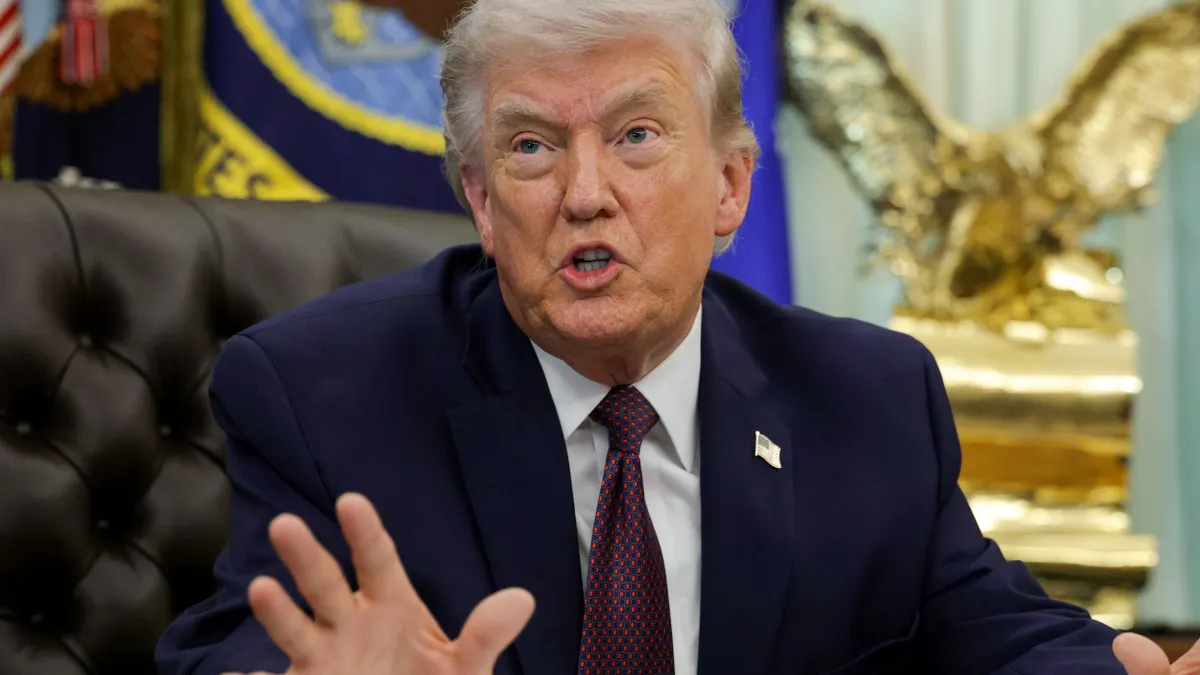
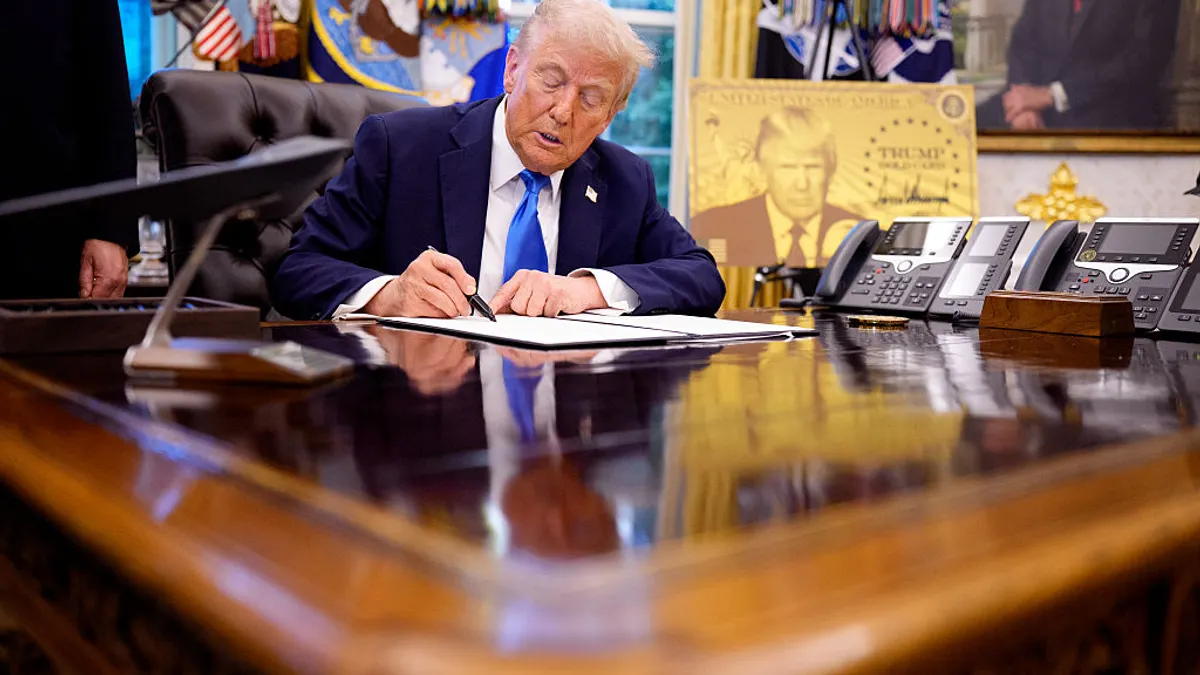
The agreement marks the Trump administration’s latest move to downsize — and eventually dismantle — the Education Department by shifting its work to other agencies. Congressional approval would be needed to fully eliminate the agency.
Aissa Canchola Bañez, policy director of the legal and advocacy nonprofit Protect Borrowers, called the transfer of the loan portfolio “irresponsible, reckless, and bad news for our most vulnerable student loan borrowers,” in a Thursday statement.
Kyra Taylor, staff attorney at the National Consumer Law Center, echoed that sentiment.
“Moving default collections and student loan servicing to the Treasury raises a new set of obstacles and uncertainty with no plan in place to resolve them,” Taylor said in a Thursday statement. “The stakes are high; any errors in the system that collects on defaulted loans and services loans in good standing will have devastating effects on families.”
Meanwhile, the Heritage Foundation, the conservative think tank that spearheaded the Project 2025 blueprint for Trump’s second term, called the transfer of power “the most significant effort to streamline student loans since the Higher Education Act.”
And Michigan Republican Rep. Tim Walberg, chair of the House education committee, praised the decision as “a smart, practical change.”
“Treasury already handles large, complex financial systems, so it’s well positioned to manage student aid more efficiently and responsibly,” Walberg said Thursday. “This shift will simplify how aid is delivered, reduce delays, and make better use of taxpayer dollars. Most importantly, it will make the process easier and more reliable for students and families who depend on this support.”
Congress’s 2026 fiscal year budget package does not outright bar the Education Department from entering into these agreements. But an accompanying nonbinding statement strongly condemned these moves.
The bicameral and bipartisan statement argued that “fragmenting responsibilities for education programs across multiple agencies will create inefficiencies, result in additional costs to the American taxpayer, and cause delays and administrative challenges in Federal funding reaching States, school districts; and schools.”
It also called for the Education Department and its partner agencies to update Congress biweekly about the status of the interagency agreements.