Dive Brief:
- The Trump administration’s sudden cancellation of over 100 federal teacher training grants last year caused at least 127 teacher candidates to drop out of their programs and another 259 accepted candidates to not enroll after all.
- Survey findings released Thursday, based on 36 grantees across 22 states, further show that before being canceled, the grants were being used to help educate future teachers to work in Title I schools or in high-need areas, such as STEM, early childhood education and special education.
- The research results from three educator groups illuminate concerns that some educator preparation experts had over the February 2025 grant terminations, including that they would hurt efforts to address hard-to-staff teaching positions.
Dive Insight:
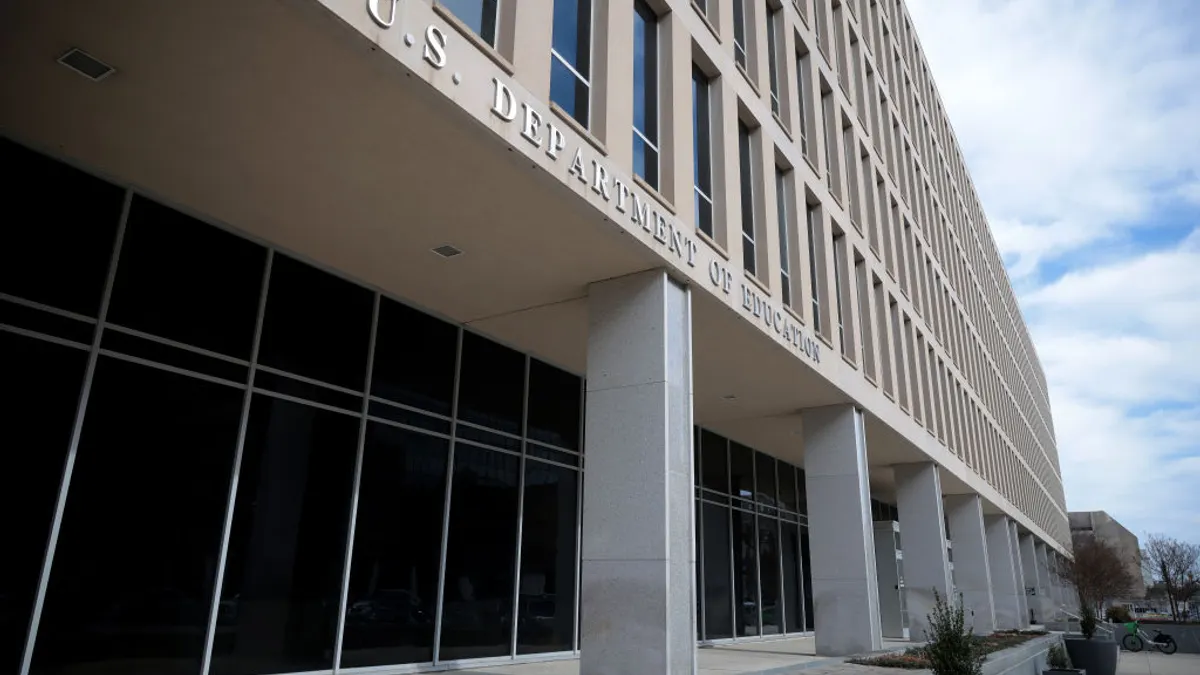
The survey focused on the effects seen from the cancellation of the Teacher Quality Partnership and Supporting Effective Educator Development programs. The report cited a March 12 court filing in which the U.S. Department of Education confirmed it had canceled 104 of the 109 active TQP and SEED grants.
Survey respondents said their grants were being used to train teacher candidates in 210 school districts before they were canceled. The 36 surveyed grantees had been awarded almost $263 million for the programs, and about half of that was canceled by the Trump administration.
The Education Department said it canceled the grants because the funds were being used to train teachers using “divisive ideologies.”
Thursday's report, which was released by the National Center for Teacher Residencies, American Association of Colleges for Teacher Education, and Deans for Impact, is based on a survey conducted between February 23 and June 5.
The survey report, however, said that programs impacted by the grant terminations were primarily focused on supporting teacher candidates to address teacher shortages. Some 74% of the affected grantees surveyed said they had been using the federal funds to provide teacher candidates with scholarships and living stipends. The survey also found that at least 1,800 teacher candidates had received direct financial support from the grants before they were canceled.
“We know that we had teacher candidates who were very close to finishing their programs who dropped out because many of these cancellations impacted the stipends, and they were unable to continue because it was a financial burden to them,” said Erica Romero, managing director of policy at the National Center for Teacher Residencies, during a Thursday online presentation on the survey’s findings.
The grant cancellations took a “direct hit” on the teacher shortage areas “that this nation most deeply needs,” Romero said, including teachers serving multilingual learners and students with disabilities or in rural schools.
In September, a federal judge vacated an Education Department anti-diversity, equity and inclusion directive that was used to justify the cancellation of the roughly $600 million total in awarded TQP and SEED grants, as well as other grant programs that support teacher prep. Ruling in a lawsuit filed by eight states challenging the TQP and SEED cuts, U.S. District Judge Angel Kelley on Sept. 17 said the anti-DEI directive and the Trump administration’s related termination of the teacher training grants were unlawful.
The Education Department had not appealed Kelley's order as of publication time on Friday.
Meanwhile, NCTR, AACTE and Deans for Impact are calling for Congress to fund TQP at $130 million and SEED for $132 million for fiscal year 2027. The groups are also advocating for statutory language in all appropriations bills to include “explicit protections requiring executive agencies to expend appropriated funds strictly as designated by Congress, in order to prevent arbitrary funding terminations or administrative diversions.”