Dive Brief:
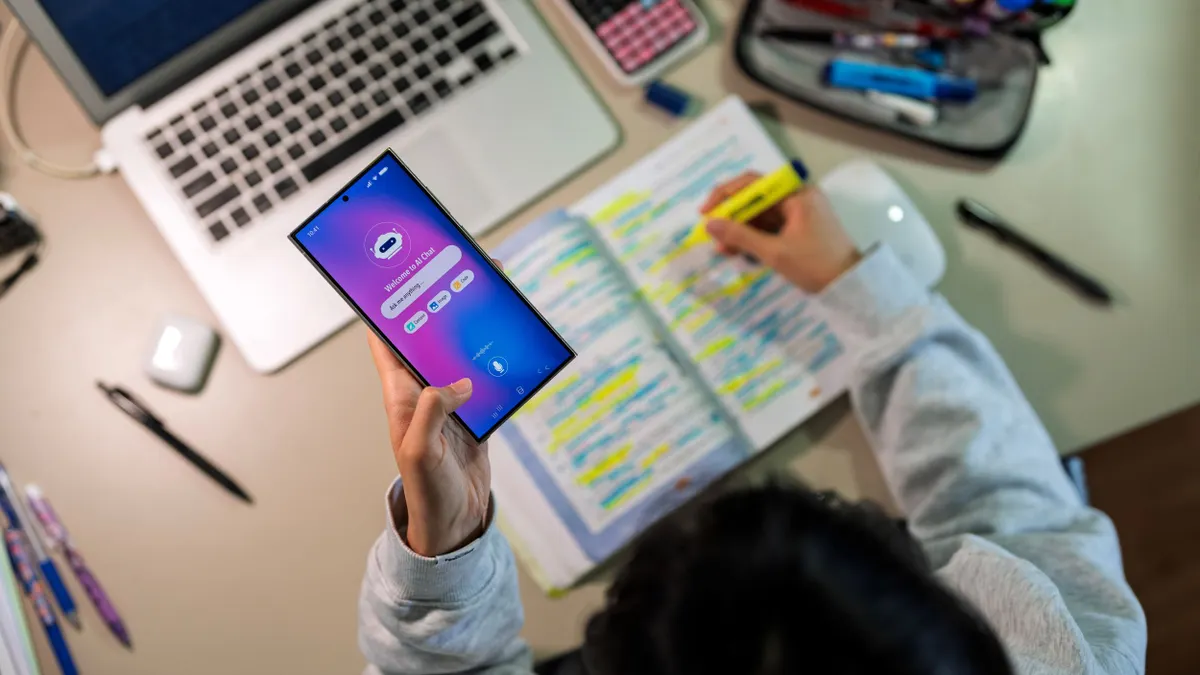
- Students in middle and high school are increasingly using artificial intelligence to help with their homework, according to a study released Tuesday by the Rand Corp.
- Rand found that the percentage of middle schoolers who used AI for homework increased from 30% to 46% between May and December 2025. For high schoolers, it jumped from 49% to 63%.
- However, this increased reliance on AI is also drawing skepticism, as more secondary students said using the technology for schoolwork can harm their critical thinking skills in December compared to 10 months earlier, Rand found.
Dive Insight:
While a growing percentage of students are using AI for homework, only about 1 in 3 middle and high school students reported that their school had a schoolwide rule about doing so, Rand said.
Additionally, the study found that just 9% of middle schoolers and 7% of high schoolers said their schools permit them to use AI for homework.
Aside from using AI directly to get homework answers, most students said they didn’t believe using AI in other ways — such as for brainstorming or looking up facts — for their schoolwork constituted cheating, according to Rand.
Rand’s findings highlight a growing challenge schools face — students’ use of AI tools is typically outpacing the ability of teachers and schoolwide policies to keep up.
At the same time, new evidence released this month from Stanford University’s SCALE Initiative suggests AI tools are being used in schools faster than research can gauge their effectiveness. The initiative, which focuses on K-12 research and policy, released a report analyzing over 1,100 research papers on AI in K-12 education and found that only 20 of those studies actually evaluated the impact AI tools have on students or teachers.
Within those 20 studies, the SCALE Initiative identified several trends. For instance, AI tools designed with certain guardrails — like tutoring programs that offer hints or guided reasoning — demonstrate more promising results than generative AI chatbots that directly give students answers. Another trend among several of the rigorous studies found that AI tools can help teachers spend less time preparing lessons, improve their instructional quality through automated insights, and help them ask students more guided questions through real-time suggestions.
Still, many questions remain unanswered on the use of these tools in classrooms. One of the major research gaps is a lack in high-quality causal studies of student AI use in K-12 classrooms, the initiative said.
“Most discussions about AI in education focus on new tools, predictions about the future, or opinions about what schools should do next,” the SCALE Initiative’s analysis said. “While the research is early, it’s important that these education system decisions are grounded in evidence: What does the current causal evidence actually show?”
As more students continue to use AI for their homework, Rand recommends that principals and district leaders explicitly inform students when they can and cannot use AI. Schools should also facilitate conversations with students about their views on AI use and how they think the tools will impact their development and critical thinking skills.
Teachers should also ask students for suggestions on how they could productively use AI for homework help, Rand said.
“These findings suggest schools need to be explicit about when and how AI can be used,” said Heather Schwartz, vice president of Rand’s Education, Employment and Infrastructure division, in a Tuesday statement. “Students are already using these tools. The question is whether schools can help them use AI in ways that deepen, rather than erode, their critical thinking.”